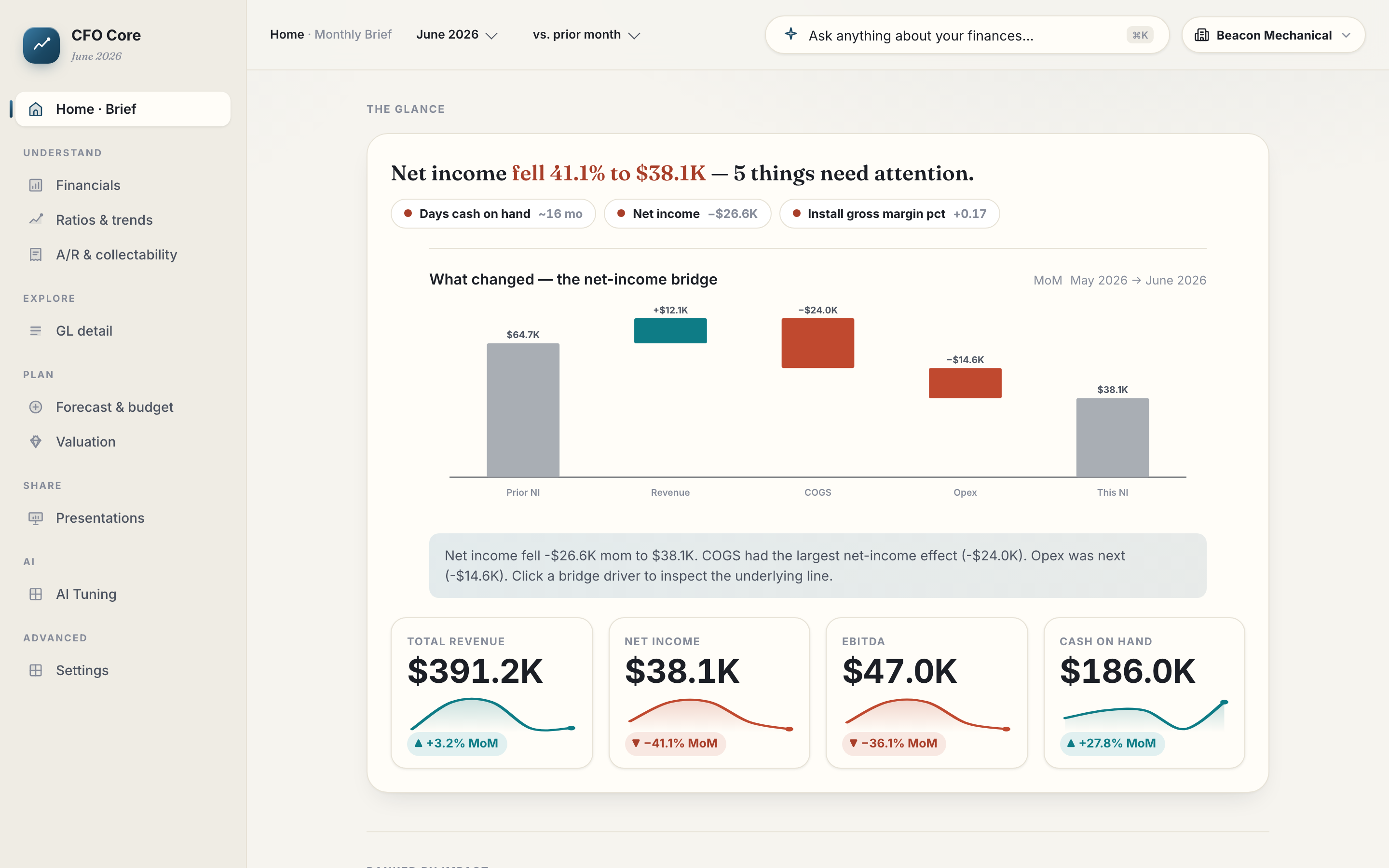
You're the controller, the accounting manager, the whole finance team of one. A Books-Trust readiness score and materiality-aware flags surface the anomalies worth your review before leadership ever sees the financials — and every figure the AI writes links to the transactions behind it, so you can stand behind it in the board meeting.
The AI drafts. You review, adjust, and sign. Nothing about your books changes.
Live product — sample data (Beacon Mechanical, a fictional company). Open this screen live — no signup →
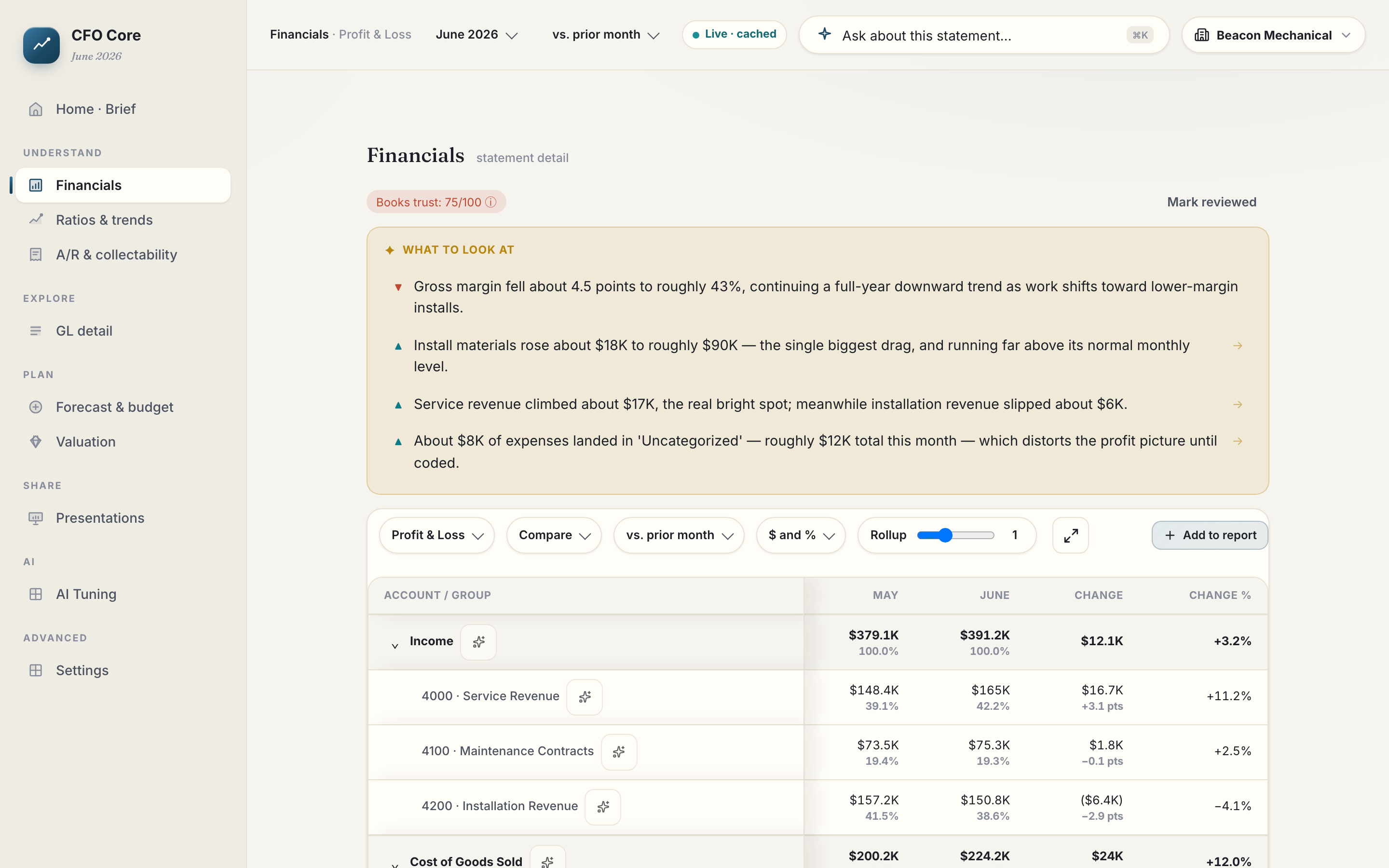
Every close, FuseGrid reads the books and hands you a Books-Trust readiness score plus the handful of lines that don't look right — an account that's uncategorized, an accrual that looks missing, a round-number plug, a margin that moved. The flags are materiality-aware, so you review the $40,000 anomaly and skip the $40 rounding. Same-day "here's what stood out," before anyone upstairs opens the deck. And when you confirm or correct a flag — "that rental is right, it's the new crane lease" — it remembers: told once, the flag stops firing, and the reasoning is saved for next month's close.
The question isn't whether the numbers foot. It's whether you'd want to explain them.
Live product — sample data (Beacon Mechanical, a fictional company). Open this screen live — no signup →
Pin the numbers that matter, and the AI drafts the narrative around them — "margin slipped because Install materials ran over the pattern on the Corrigan Builders job, and A/R is stretching." You edit the story to your voice, then export a polished PPTX or PDF, or send a revocable no-login link. What used to be a weekend of copy-paste and formatting is a deck in minutes.
From a lost weekend to eleven minutes — and it still sounds like you wrote it.
June revenue came in at $391.2K; the story is margin — down about 4.5 points to 42.7% because Install materials on the Corrigan Builders job ran over the pattern. Net income fell 41.1% to $38.1K. Cash is $186.0K. Collections slowed: DSO is up 5 days to roughly 41.
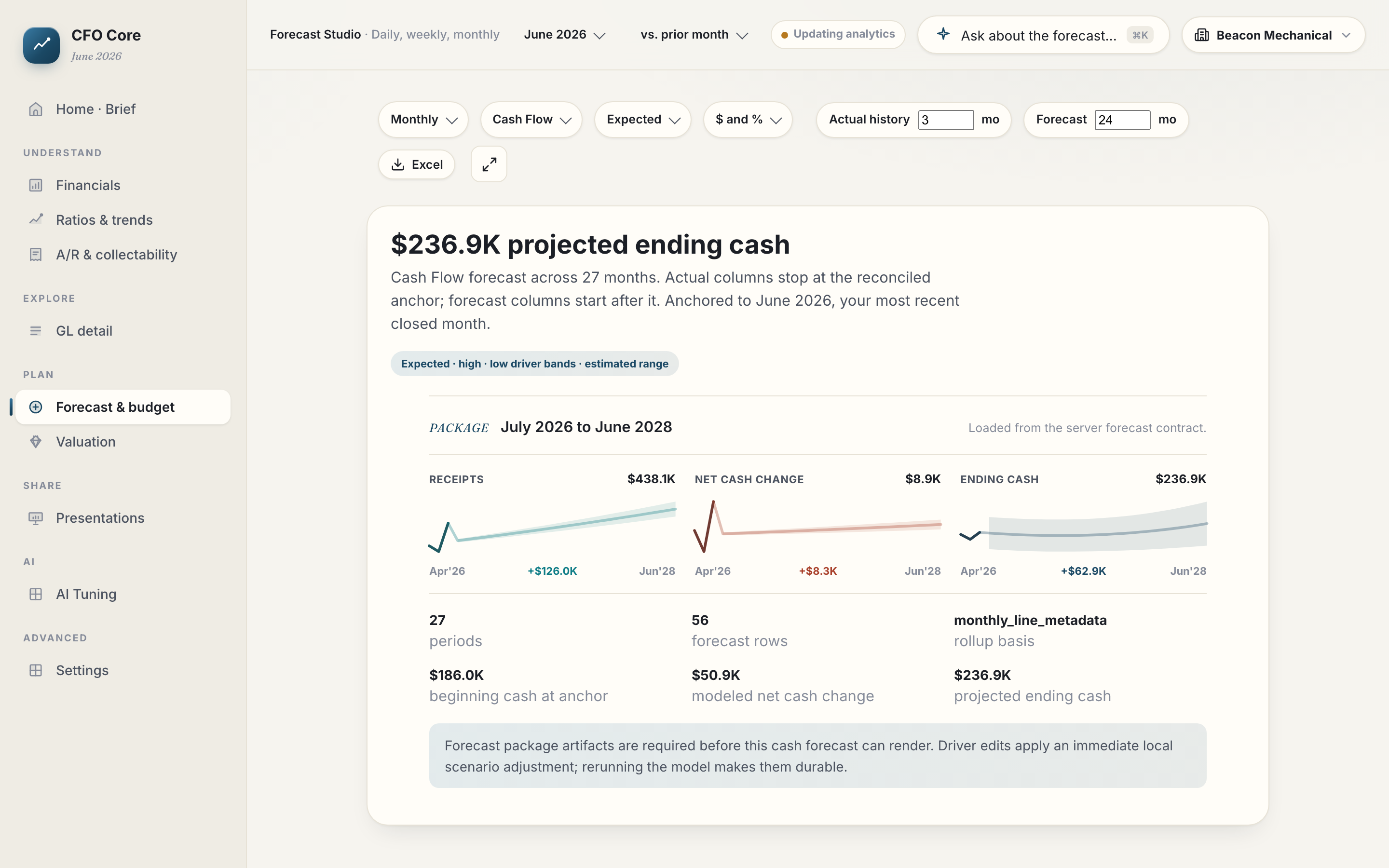
A timing-aware 13-week cash forecast reads what's scheduled — payroll, receivables, the quarterly insurance premium — and shows you the trough before it arrives: for Beacon, the tight week is the one where biweekly payroll and the insurance premium land together, flagged weeks ahead. The same studio runs the monthly model out 24 months — Beacon's $186.0K of cash today projects to $236.9K by mid-2028. And pacing tracks the current month against forecast on elapsed days — on day 12, you know you're pacing to plan, not guessing from a run-rate that hasn't caught up yet.
The best cash surprise is the one you saw three weeks early.
Live product — sample data (Beacon Mechanical, a fictional company). Open this screen live — no signup →
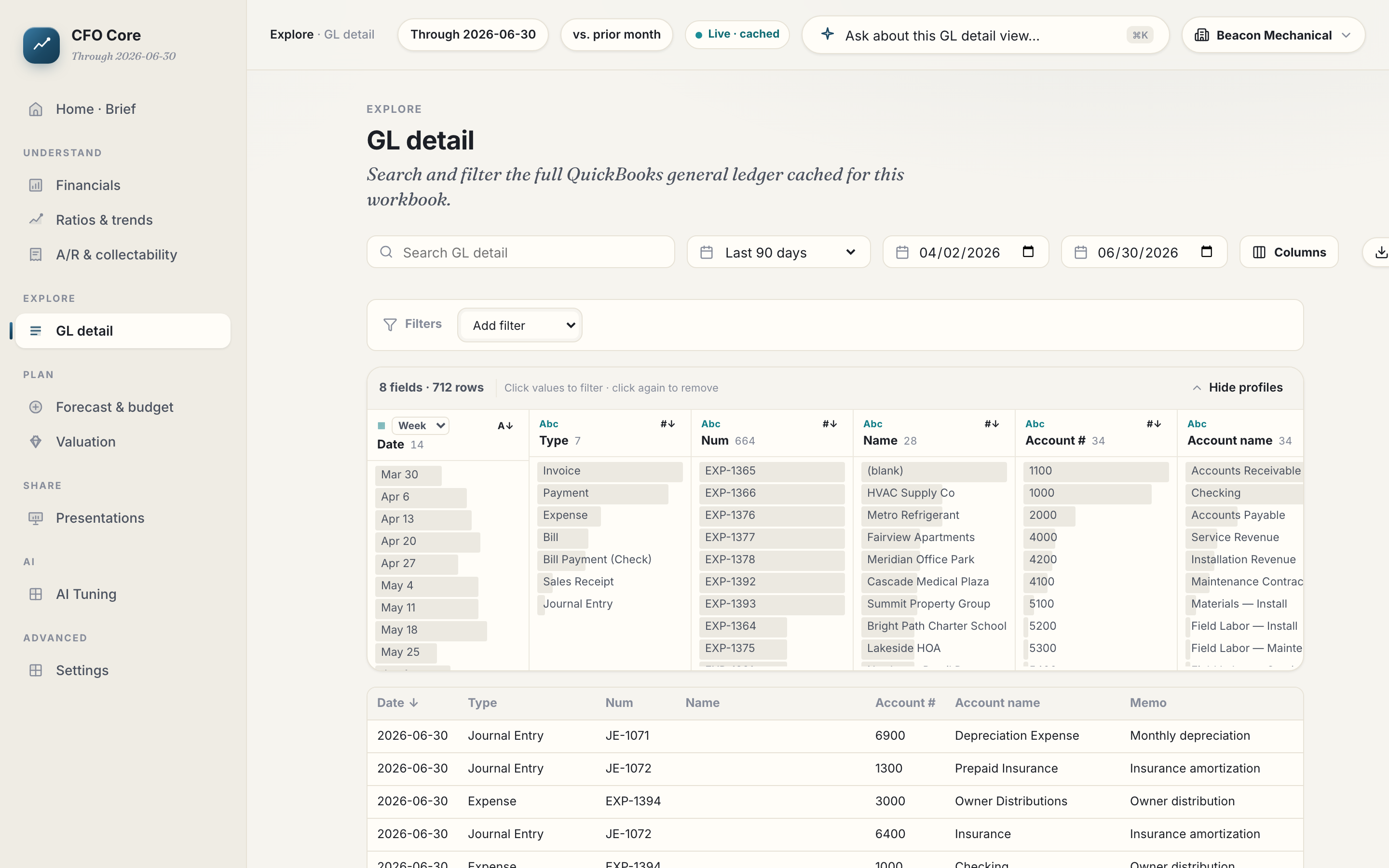
The board doesn't want a summary they have to trust. They want a number you can defend. Every figure the AI writes — every headline, every flag, every forecast driver — clicks down to the general-ledger rows that make it up. You audit the AI before the board thinks to ask, and when someone says "where did that materials number come from," you've already got the transactions open.
Live product — sample data (Beacon Mechanical, a fictional company). Open this screen live — no signup →
The numbers come from a deterministic pipeline over your general ledger — the same math every time. AI writes the explanations on top, and every figure links to the transactions behind it. Nothing reaches leadership until you've reviewed it. It replaces the grunt work — assembling the statements, rebuilding the model, formatting the deck — not your judgment or the number you sign your name to.
Pulling the close together, rebuilding the forecast, drafting the narrative, formatting the board pack. The hours that eat your close week — done, and ready for you to review.
What matters this month, how to frame it for leadership, when the number needs a caveat — that's you. It replaces the grunt work, not your judgment or your standing in the room.
This page frames FuseGrid for one company — yours. If you carry a book of clients, there's a firm cockpit that triages your whole roster and lets you brand every deliverable as your own. Same product, built for many companies at once.
No. The numbers come from a deterministic pipeline over your general ledger — the same math every time, testable and repeatable, not a language model guessing at totals. AI writes the explanations on top, and every figure it cites links to the transactions behind it. So you get plain-English commentary you can trace, not a black box you have to take on faith.
No. AI is the engine; you're the architect. FuseGrid does the assembly — pulling the statements together, rebuilding the model, drafting the board narrative, formatting the deck — the production work that eats your close week. What it can't do is decide what matters, read the room in the board meeting, or own the number when leadership pushes back. That's you. It replaces the grunt work, not your judgment.
FuseGrid connects read-only to your QuickBooks Online and leaves the books exactly where they are. It can analyze your ledger and can never change it, post to it, or reclassify a transaction. It's an advisory layer on top, not a new system of record — and nothing it drafts is visible to anyone but your finance team until you decide to share it.
You can connect QuickBooks and start free in a few minutes. The first sync reads up to five years of history and takes a few hours to assemble; after that, your annotated close, Books-Trust score, 13-week cash forecast, and a draft board deck are ready to review. First real value is same-day, not a rollout project.
You're one company, not a book of clients — so you're on the standard per-company plans. Invite your whole finance team and your outside accountant free.
billed annually
billed annually
billed annually
Connect QuickBooks, review the annotated close and the 13-week cash, and send a board pack you can defend line by line. Free for 14 days, no credit card — and it never touches your books.
Start free — 14 days →