FuseGrid turns each client's QuickBooks into the deliverables you'd bill a CFO for — an annotated close, a 13-week cash forecast, a board pack, a valuation — drafted by AI, reviewed by you, branded as yours. The advisory work you've been giving away becomes a packaged, billable service.
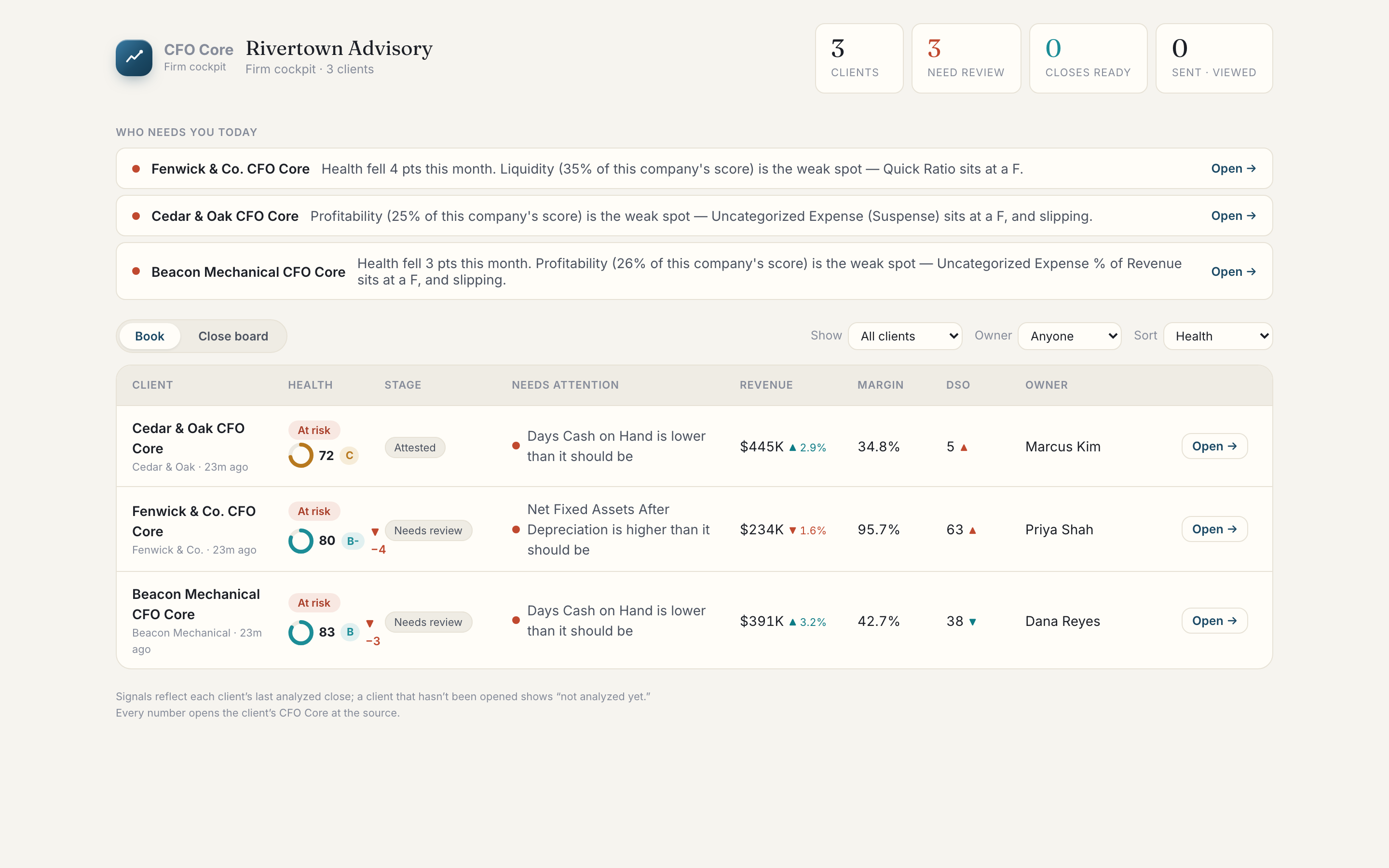
Live product — sample data (Rivertown Advisory, a fictional firm). Open this screen live — no signup →
Advisory is the profession's fastest-growing, highest-margin service line — and the one most firms can't staff. Your clients want a CFO's answers. You have the judgment. What's missing is the machine that turns clean books into CFO-grade deliverables without a CFO's hours.
Source: 2024 AICPA / CPA.com Client Advisory Services (CAS) Benchmark Survey. Billing on hours fell from 53% to 10% since 2018 — the model already changed; the tooling to deliver it profitably is the gap.
The firm cockpit reads every client's books overnight and ranks your roster by what needs a human — a margin that slipped, a close that's ready to send, a cash week worth a call, an uncategorized balance before you sign off. One click opens that client's full CFO workspace. No more opening twenty workbooks to find the one that matters.
A health score and the single top flag per client, sorted worst-first. You spend your morning on the clients that need judgment, not the ones that are fine.
"Gross margin −4.5 pts" opens the client's P&L, then the transactions behind it. You verify before you advise — audit the AI before your client asks.
The cockpit is rolling out now. See exactly what it ships →
Every client gets the full CFO workspace. You review and sign; the client sees your firm's name on it.
Same-day "what stood out," materiality-aware flags, and a Books-Trust score that catches the mess before you sign off.
A timing-aware weekly forecast per client — the payroll-week call you make before they ask you to make it.
Pin the numbers, let AI draft the narrative, export a white-label deck or send a no-login link — in minutes, per client.
A 24-month three-statement model and a defensible business value — the analysis that used to mean a $5,000 engagement.
The reason so many firms don't sell CFO-level advisory is that doing it by hand — assembling the statements, rebuilding the model, writing the board narrative — eats the margin. When the deliverables assemble themselves for your review, the same package you used to give away for free becomes a service you bill for.
The work didn't get less valuable. It got less expensive to produce.
Illustrative — the point is that the labor which used to eat the margin is gone, so the same package becomes mostly profit.
The numbers come from a deterministic pipeline over each client's general ledger — the same math every time. AI writes the explanations on top, and every figure links to the transactions behind it. Nothing reaches a client until you've reviewed it. You can audit the AI before your client ever thinks to.
The close read, the forecast, the board narrative — assembled from the client's real books, ready for your review.
You adjust, you approve, you sign. The judgment and the client relationship stay yours — that's the part that was never the grunt work.
One click from any figure to the transactions behind it. Read-only, so it can analyze the books and never change them.
FuseGrid does the assembly — statements, models, decks — that ate your evenings. What it can't do is sit in the room, read the client, and decide what matters. That's you, and it's the part clients pay for.
Read-only connection, your brand on every deliverable, and no path for us to reach your clients directly. We build the tools; you own the relationship.
The talent you can't hire is the constraint on every firm's growth. When the deliverables produce themselves and the cockpit triages your whole book, your best people spend their hours on advice, not assembly — and the practice scales without the headcount you can't find.
Priced the way you sell advisory — by the client, dropping as your book grows. Bill your clients whatever your advisory is worth; keep the difference.
No. AI is the engine; you're the architect. FuseGrid drafts the analysis and the deliverables; you review, adjust, and sign off before anything reaches a client. It replaces the grunt work — assembling statements, rebuilding the model, formatting the board pack — not your judgment or your relationship.
The numbers come from a deterministic pipeline over the general ledger — the same math every time, testable and traceable. AI writes the explanations on top, and every figure links to the transactions behind it, so you can audit it before your client asks. Nothing reaches the client until you review it.
No. FuseGrid connects read-only to each client's QuickBooks Online and leaves the books exactly where they are. It's the advisory layer on top, not a new ledger — and it can never change your clients' books.
Per client, with unlimited firm users and white-label included — dropping from $69 to $49 to $39 as your book grows past 10, 25, and 50 clients. Bill your clients whatever your advisory is worth; the wholesale rate is your margin. Full pricing →
It's rolling out now. The per-client CFO deliverables — close, cash, board pack, forecast, valuation — are live today; the firm-scale layer (per-client billing, staff views, deeper white-label) is on the roadmap. We'd rather show you exactly what ships than promise one. What the cockpit ships →
Connect one client's QuickBooks and see the annotated close, the 13-week cash forecast, and the white-label board pack on real books — free for 14 days, no credit card.
Start with one client — free 14 days →